


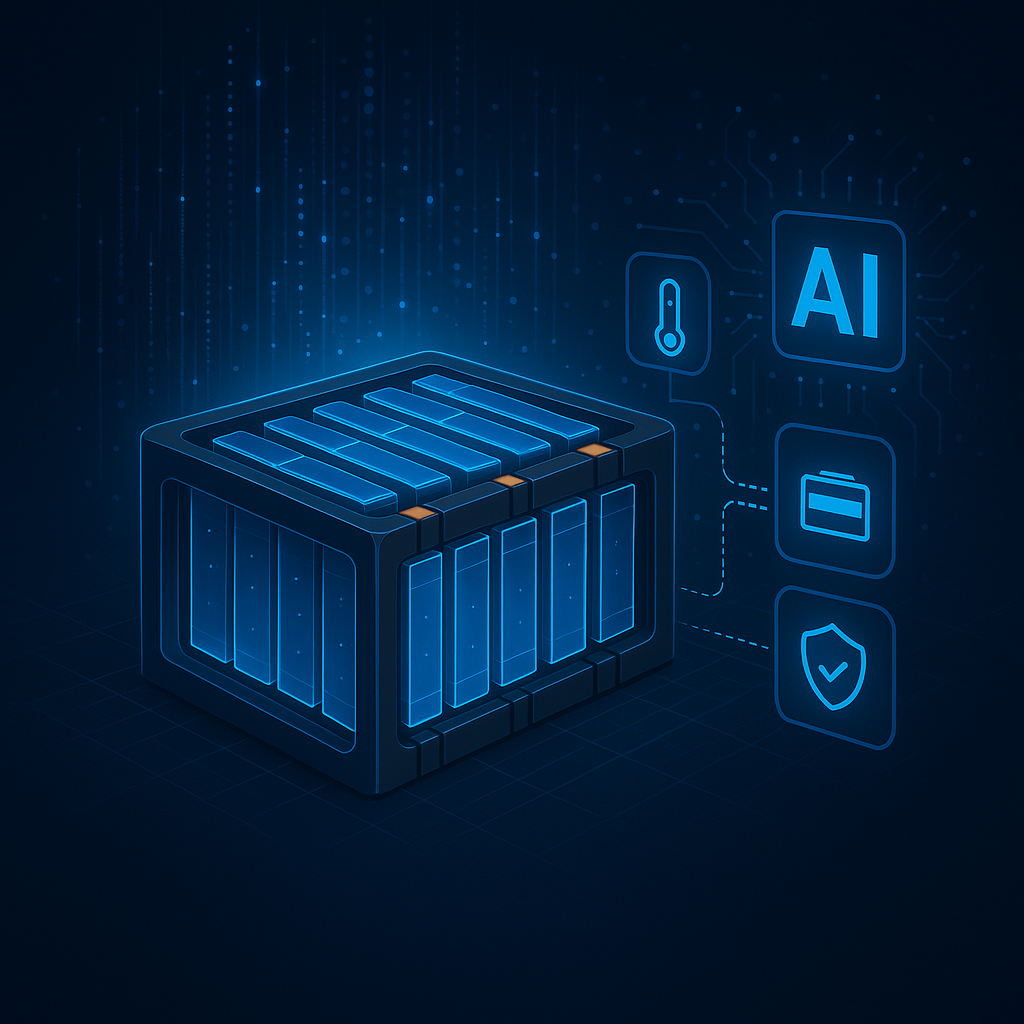
AI-Powered Battery Management Systems (BMS): When Batteries Think for Themselves
Lithium-ion batteries are the backbone of modern technologies—from electric vehicles and stationary energy storage to industrial applications. As energy density increases, so do the demands for safety, reliability, and cost efficiency.
This is where AI-powered battery management systems (BMS) come into play. They do more than simply monitor batteries: they analyze behavior, detect risks early, and make intelligent decisions in real time.
While traditional BMS rely on fixed thresholds and simple algorithms, AI-based systems use machine learning and data models to understand complex interactions in battery operation—and derive concrete, actionable insights from them.
Why Battery Management Without AI Reaches Its Limits
Conventional battery management systems provide essential protection functions such as overcharge protection, deep-discharge protection, and temperature monitoring. However, modern battery systems have become far more complex:
- different cell chemistries within a single product line
- highly variable load profiles
- aging processes that develop individually and non-linearly
- safety-critical applications with high liability and failure risks
Rigid thresholds often react only after a critical condition has already been reached. AI-powered BMS intervene earlier: they detect patterns, anomalies, and trends long before a safety-relevant event occurs.
How AI-Powered Battery Management Systems Work
An AI-based BMS combines classic sensor data with data-driven analytical models. Typical data sources include:
- cell voltages and current flows
- temperatures of individual cells and modules
- charge and discharge cycles
- environmental conditions
- historical operating and aging data
Based on this information, the system continuously learns what is “normal” for a battery—and what is not. Deviations are not only detected but also contextualized. For example, a temperature increase is evaluated differently depending on the state of charge, battery age, or prior usage behavior.
Key Advantages of AI-Powered BMS
Early detection of safety risks
AI models identify signs of thermal runaway, internal short circuits, or cell imbalance much earlier than conventional systems. This enables preventive action instead of reactive emergency shutdowns.
Extended battery lifespan
Intelligent charging and discharging strategies adapt operation to the actual condition of the battery. Overstress is avoided, and aging processes are slowed.
More accurate state-of-health assessment
AI-powered BMS provide far more precise insights into the true health status of a battery—an essential basis for maintenance, second-life use, or recycling decisions.
Optimized energy efficiency
Predictive control reduces energy losses, optimizes charging times, and makes better use of available capacity.
Typical Application Areas for AI-Powered Battery Management Systems
- Electromobility: real-time monitoring of traction batteries, range predictions, safety management during fast charging
- Stationary energy storage: grid stabilization, load management, aging forecasts
- Industry and logistics: industrial trucks, autonomous systems, high-performance batteries in continuous operation
- Recycling and take-back: assessment of battery condition for safe storage, sorting, and reuse
Especially in safety-critical environments, AI offers a decisive advantage by enabling data-based risk assessment and prioritization.
Legal and Operational Relevance
As the use of lithium batteries grows, so do the requirements imposed by insurers, authorities, and occupational safety regulations. Companies must be able to demonstrate that they:
- know the condition of their battery systems
- systematically monitor risks
- implement preventive protective measures
AI-powered BMS provide reliable data and documentation to meet these requirements. They help companies fulfill their duty of care and reduce liability risks—particularly in the event of fires, failures, or damage.
Practical Recommendations for Companies
Organizations that use lithium batteries on a larger scale should:
- rely on battery management systems with predictive analytics capabilities
- centrally collect and evaluate battery data
- clearly define warning and escalation levels
- integrate BMS data into safety, maintenance, and disposal concepts
- train employees in handling AI-powered systems
The combination of technology, organization, and training is crucial for safe and cost-effective operation.
RETRON Solutions for Intelligent Battery Management and Safety
RETRON supports companies throughout the entire life cycle of lithium batteries—from safe use to disposal:
- safety and storage solutions for lithium batteries and modules
- systems for controlled collection and evaluation of batteries
- consulting on legally compliant processes and risk minimization
- solutions for transport, take-back, and recycling
Combined with modern, AI-powered battery management systems, RETRON solutions create a robust foundation for maximum safety, transparency, and future readiness.
AI-powered battery management systems represent the next evolutionary step in handling lithium batteries. They make battery systems not only more efficient, but above all safer.
Companies that adopt intelligent monitoring and data-driven decision-making early on reduce risks, extend system lifespans, and meet increasing regulatory requirements—sustainably and with a view to the future.